The United States had defeated the British and sent the aristocratic monarchy back to Europe. Since Jefferson’s Declaration of Independence the country had been run according to the Articles of Confederation (AOC), the 13 colonies’ constitution if you will. Being the first attempt at formulating a national government, there were obviously certain flaws. In the 1780’s the ideals of 1776 were seriously threatened not by the government, but by the people. The founders’ articles, in an attempt to make sure the tyranny of Britain never showed up in America, made the central government far too weak, and delegated far too much power to the state governments.
During the Revolutionary War, most states had been solidifying their governmental practices with written constitutions. These constitutions demonstrated the ideas of the era: term limits, equal suffrage among men, and a bill of rights. The states wanted to make sure the people’s liberties were protected under the newly formed governments. With this degree of self preservation in mind, the states could not anticipate a new kind of tyranny caused by too much power in the hands of the people.
Under the AOC, the central government was so weak in comparison to the state-run governments, it could not impose taxes or regulate commerce between colonies, had no executive branch or national court system, and could only amend the Articles of Confederation with unanimous consent of all the states.
The straw that broke the camel’s back came in 1786, when Daniel Shays led an armed rebellion of nearly 2000 farmers in Massachusetts and closed the courts in three counties preventing creditors from collection debts. This violent action sealed the deal for the founders and in 1787, after delegates from five states met in Annapolis, MD, the Constitutional Convention was held in Philadelphia to revise and amend the AOC. However, all at the convention decided a new Constitution was needed.
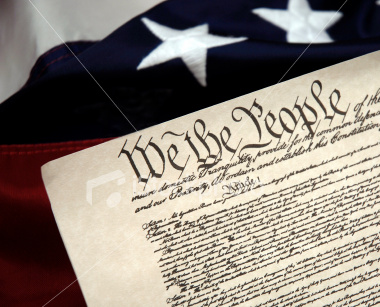
In the United States Constitution, the founders needed to develop a strong central government that could unify the colonies into united states. Drawing from the experience of the state governments and constitutions, those attending the closed-door convention were able to hypothesize what kind of governmental structure would work best. What they came up with was a three branch system consisting of legislative, executive, and judicial branches.
The most powerful branch, the legislative, dealt with representation of the people. As a compromise of the Virginia and New Jersey plans, Article One of the U.S. Constitution allowed for a bi-cameral Congress. In the House of Representative, representation is based on population. In the Senate, however, each state is given 2 votes. This way the large states felt they were represented fairly in the house, and the smaller states still believed their interests could be represented in the senate. Article Two asserts, “The executive power shall be vested in a President of the United States of America.” The job of the President it to execute the laws of congress, lead the government, interface with foreign leaders, and is the Commander in Chief of the U.S. Military. And last but not least, Article Three states, “The judicial Power of the United States, shall be vested in one supreme court and in such inferior Courts as the Congress may from time to time ordain and establish” Their main function is that of judicial review where they review the state and federal laws if they are challenged and deem them constitutional or not.
The new government was set up with three branches to keep the powers separate. This separation of powers was to be maintained with a system of checks and balances where each branch has a role in the actions of the other. With this system, however, some people still felt that the new constitution gave too much power to the central government, and thought the AOC were fine as they were. These people became known as Antifederalists. Although Antifederalists conceded that some reforms in the AOC were needed, they denied that there was a crisis that necessitated a new constitution. They saw this new government as a threat to liberty. The Antifederalists, not an organized group, but a diverse assortment of individuals who opposed ratification, felt that a government so far removed from the people could not accurately represent them.For this reason they thought the only way to have liberty, was for people to feel connected to their government—hence strong local and state governments.
On the other side of the coin, the Federalists, those in favor of ratification of the new constitution, conversely felt that with an increasingly heterogeneous culture, the only way to protect liberty was with the expansion of a single republican government to cover a large area with a diverse population. The Federalist, 85 essays published in New York newspapers to convince New York to ratify the constitution, exhibited the views of federalists James Madison, John Jay, Alexander Hamilton, and George Clinton.
James Madison, in his Federalist paper #10, spoke out on the issue of factions, the principle cause for trouble in a democratic society. Madison said the only way to get rid of factions was to either destroy liberty or force citizens to all have the same ideals and interests. According to Madison, a faction is, a number of citizens, whether amounting to a majority or minority of the whole, who are united by some common impulse of passion adverse to the rights of other citizens or interests of the community. He is saying that a faction is any group of people who have similar ideals, goals, and interests who band together to achieve those goals.
These factions, with their desire to achieve theirs goals, are proven harmful to government and liberty when they taint public administrations. The U.S. was becoming more heterogeneous. There is no way to force all people to share interests, and Madison in no way believes destroying liberty would be wise. Therefore the solution he offers in regards to factions is to control the effects of factions. The way to control factions, according to Madison, is under the constitution, “I may clog the administration, it may convulse the society; but it will be unable to execute and mask its violence under the forms of the Constitution.”
Antifederalists felt the country needed to stay small and homogeneous in demographic. They sought to protect the values the country against what they perceived as an attack by the Federalists. The only way for equality and liberty to live, they thought, was for people to participate directly in government. The Constitution was a shift away from civic humanism. The Lockean ideals adhered to were the spark for the revolution, but the community effort of the colonies, civic humanism, is what kept the fire burning. Once the British were gone, people wanted their personal rights—their individual freedoms. Therefore, in a large republican government people did not share either concerns or customs…the public good would be lost in all the conflicting interests.
Antifederalists and Federalists could be considered polar opposites. When analyzing which view is better, however, one must realize that weather liberty is more stable in a small government close to the people or in a large, powerful, distant government depends on the society being governed. For instance, the position of the Antifederalists, who felt liberty would only be secure if government were kept small, close to the people, and under their control. In their culture, a direct democracy form of government would work because most everyone would be striving for the public good. The closest actual example in America was seen post Revolutionary War, under the AOC, where the states were not looking out for the good of the nation but only the individuals within their borders, creating less stability as a whole. Therefore the republican government established in the U.S. Constitution allowed for more stable United States governed by a more powerful central government able to withstand the tests of time.
Jefferson and Hamilton present two extremes, where one “dreamt” property ownership could create a feeling of community and values. The other “dreamt” capitalism should prevail appealing to the individual, analogous with Lockean ideals. Then there was Madison, who had no dream. That is what the U.S. Constitution brought to the United States, a middle ground between public good and individual values, where natural rights are upheld.


No comments:
Post a Comment